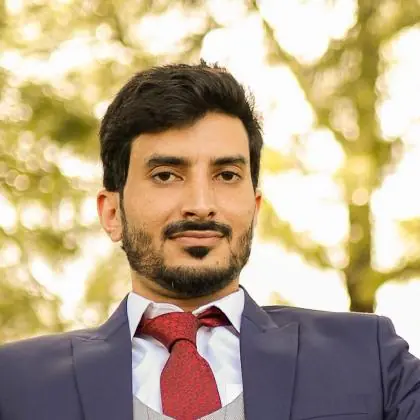
Khurram KhalilI am a PhD student in Computer Science at the University of Missouri-Columbia, working on GenAI optimization and AI hardware security. My research focuses on efficient model compression, adversarial robustness, formal verification, and hardware-aware deployment for edge and cyber-physical AI systems. I build methods that make large language and vision-language models smaller, faster, more reliable, and safer to deploy under real constraints: energy, latency, fairness, thermal safety, accelerator faults, and hardware-induced failures. Research thesis: The next generation of useful AI systems will be judged not only by capability, but by whether their internal representations are predictable, their deployment costs are controlled, and their hardware-level failure modes are understood. |
|
ResearchMy work currently centers on three connected directions: Predictive Geometry of LLM Representations, GenAI Optimization, and AI Hardware Security. |
Recent WritingLonger notes on the systems and security questions behind my papers. Browse the blog. What Bit-Flip Attacks Reveal About Multimodal LLMsHow FlipLLM finds sparse hardware faults that collapse language and multimodal models, and why the defensive result matters more than the attack headline. |
NewsOct 23, 2026 Our paper Spectral Rank and Step-Direction Dynamics in Language-Model Post-Training, with my supervisor Professor Khaza Anuarul Hoque, was accepted in Transactions on Machine Learning Research (TMLR). 2026 RIFT won the DATE 2026 Best Paper Award in the T Track for Test and Dependability. 2026 IEEE Computer Society WEIGD Student Support Fund. 2026 FlipLLM published at IEEE HOST 2026. 2026 Received Best PhD Student in ECE Department. 2026 Paper selected for presentation at Meta workshop in HRI 2026. 2026 IEEE HOST NSF Travel Funding Support. 2025 IEEE CEDA and CASS Travel Awards. |
|
Predictive
Geometry |
Predictive Geometry of LLM Representations
Khurram Khalil Attention sinks, semantic trajectories, representation geometry, hallucination prediction. I am increasingly interested in whether the internal geometry of LLM representations can predict model behavior before the final answer appears. Explore predictive geometry research. |
|
GenAI
Optimization |
Specification-guided compression and deployment of GenAI systems
Khurram Khalil LLM/VLM compression, edge AI, temporal logic, energy-aware design, efficient attention. I study how generative models can be compressed and deployed while preserving useful behavior under constraints such as energy, latency, fairness, and runtime safety. Explore GenAI optimization research. |
|
Hardware
Security |
AI hardware security, fault attacks, and secure model deployment
Khurram Khalil Bit-flip attacks on LLMs, accelerator faults, approximate DNN faults, hardware-aware robustness. I evaluate how AI models fail under hardware faults and accelerator-level attacks, and design methods to make these systems more resilient under deployment constraints. Explore AI hardware security research. |
Selected Publications |
TMLR 2026 |
Spectral Rank and Step-Direction Dynamics in Language-Model Post-Training
K. Khalil, K. A. Hoque Transactions on Machine Learning Research (TMLR), 2026. Accepted October 23, 2026. Separating spectral concentration, energy coverage, and the direction of successive weight updates during language-model post-training. OpenReview |
HOST 2026 |
FlipLLM: Efficient Bit-Flip Attacks on Multimodal LLMs using Reinforcement Learning
K. Khalil, K. A. Hoque IEEE International Symposium on Hardware Oriented Security and Trust, 2026, pp. 356-366. doi |
DATE 2026 |
RIFT: A Scalable Methodology for LLM Accelerator Fault Assessment using Reinforcement Learning
K. Khalil, M. M. Khaliq, K. A. Hoque Design, Automation and Test in Europe, 2026, pp. 1-7. Winner of the DATE 2026 Best Paper Award, T Track, Test and Dependability. doi / award |
ICCAD 2025 |
TOGGLE: Temporal Logic-Guided Large Language Model Compression for Edge
K. Khalil, K. A. Hoque IEEE/ACM International Conference on Computer-Aided Design, 2025. doi |
MoreFor projects, full publications, academic service, CV, and longer writing, use the links at the top of this page. |
| Last updated: 2026 |